
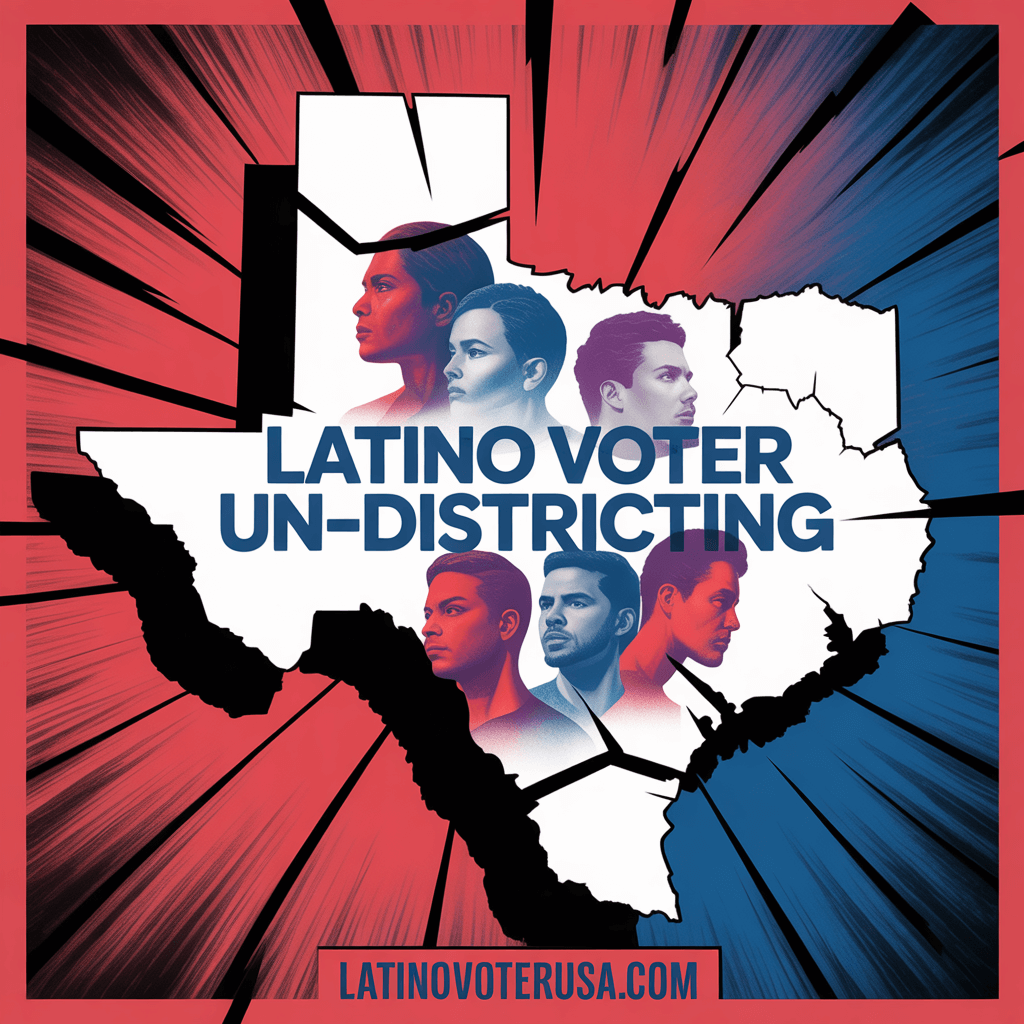
Texas Redistricting Latino Voters: The Map Wars Begin
August 25, 2025
Texas redistricting has turned into a full-contact sport, and Latino voters are about to find out they're not just spectators in this game – they're the prize everyone's fighting over. While politicians in Austin and Sacramento draw lines on maps like kids playing with crayons, millions of Latino families are watching their political power get carved up, redistributed, and sometimes completely erased by people who've never had to worry about whether their vote actually counts.
Picture this scenario: Rosa Martinez has lived in the same neighborhood in San Antonio for fifteen years. She votes in every election, knows her representative's name, and has even attended town halls to ask questions about healthcare and immigration. Then one morning, she wakes up to discover that some politicians in Austin have decided her neighborhood now belongs to a completely different congressional district – one that stretches all the way to rural counties where her concerns about bilingual education and affordable healthcare suddenly don't matter as much as cattle ranching and oil drilling.
This isn't some abstract political theory we're talking about. This is the reality of Texas redistricting Latino voters are facing right now, and it's happening with the surgical precision of a team that knows exactly what they're doing. The August 2025 congressional map that Texas Republicans pushed through isn't just about drawing new lines – it's about making sure that Latino voices get diluted, scattered, and ultimately silenced in districts designed to guarantee Republican victories for the next decade.
The math here is as brutal as it is simple. Texas has seen massive demographic shifts over the past ten years, with Latino populations growing in cities and suburbs across the state. In a fair system, this growth would translate into more political representation and more influence over policies that affect Latino families. Instead, Texas Republicans looked at these numbers and decided the best response was to pack Latino communities like sardines, pushing them into a handful of districts to limit their impact.
What makes this particularly infuriating is how transparent the strategy has become. The new Texas map eliminates competitive districts with the efficiency of a factory assembly line, creating safe Republican seats that stretch across geographic areas that have nothing in common except the political convenience of keeping Latino voters from building coalitions. It's gerrymandering so obvious that even the politicians doing it have stopped pretending it's about anything other than preserving power.
But here's where the story gets interesting: California Democrats, led by Governor Gavin Newsom, are preparing to fight fire with fire. Newsom's proposal for a special election to redraw California's congressional districts isn't just political theater – it's a direct response to Texas's power grab, and it could potentially eliminate five Republican seats in California. The message is clear: if Texas wants to play hardball with redistricting, California is ready to step up to the plate.
The proposed California redistricting plan has sparked exactly the kind of heated debate you'd expect when politicians start redrawing the political map in real time. Polls show significant support for Newsom's initiative among California voters who see it as protecting Democratic interests in a state that's been reliably blue for decades. But critics are calling it a retaliatory measure that could make the national political divide even worse, and they're not entirely wrong.
This is where Texas redistricting Latino voters become the key to understanding what's really at stake in this map war. Both Texas and California are home to massive Latino populations that have the potential to swing elections, influence policy, and determine the direction of American politics for generations. In Texas, Latino voters have been increasingly organized and mobilized to challenge Republican dominance, building grassroots networks that register voters, educate communities about issues, and turn out families who might otherwise stay home on election day.
In California, Latino voters are seen as essential to maintaining Democratic control, but they're also demanding more than just being taken for granted. They want representatives who don't just count on their votes but actually fight for policies that improve their lives – better schools, affordable healthcare, immigration reform that keeps families together, and economic opportunities that help them build wealth and security.
The influence of Latino voters in both states will be absolutely pivotal in determining how these redistricting battles play out. In Texas, every new district map is a test of whether Latino political power can overcome gerrymandering through sheer numbers and organization. In California, every response to Texas's actions is a question of whether Democratic politicians will actually deliver on their promises to Latino communities or just use them as political pawns in a larger game.
As California prepares for a special election to decide on new congressional districts, Latino voters in both states are watching to see whether their voices will be amplified or diminished by these political map games. The stakes couldn't be higher: we're talking about representation, governance, and the fundamental question of whether American democracy works for everyone or just for the people with enough power to redraw the rules in their favor.
The coming months will reveal whether Texas redistricting Latino voters can overcome gerrymandering through organizing and turnout, and whether California's response will actually strengthen Latino political power or just create more partisan warfare that leaves communities behind.
Read Next:

The Scorecard: The Health Insurance Playoffs!
You are not experiencing Deja vu! We are again facing a government shutdown, the main reason for it is the lack of a hea...

Opening the Opportunity Door for the Whole Family
What is the "Opportunity Door"? Imagine our Tía Sofia. She’s the heart of the neighborhood, the o...
Tamale Inflation is the Grinch of 2025
Tamale Inflation hit the kitchen before it ever hit a cable news chyron. Not in some abstract “consumer basket&rdq...