
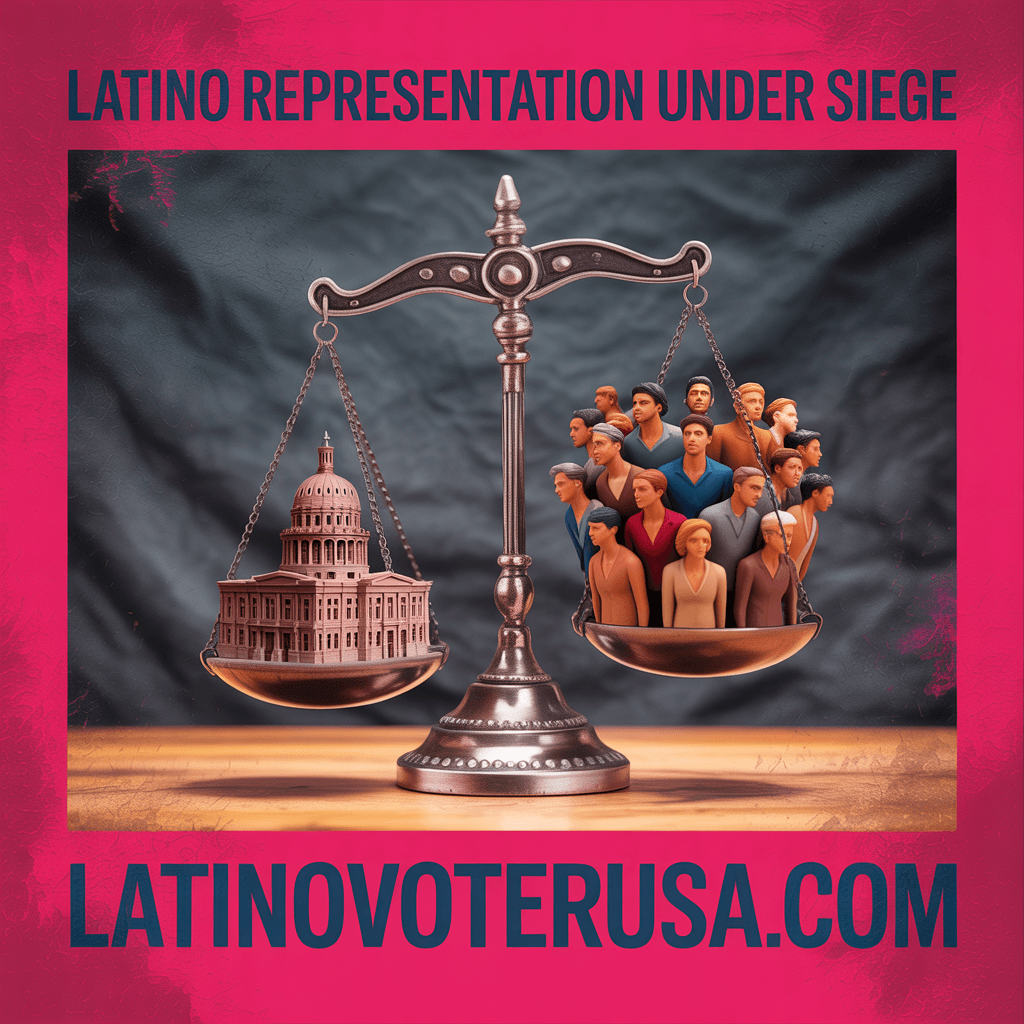
Latino Representation Under Siege in Texas
August 4, 2025 | Staff
Latino Representation matters, and nowhere is this truth more evident than in the unfolding drama across Texas, where the Republican Party's latest redistricting gambit threatens to fundamentally alter the political landscape for Latino communities. What we're witnessing isn't just another round of political maneuvering—it's a calculated attempt to reshape democracy itself, with Latino voters caught squarely in the crosshairs.
The story begins with numbers that should inspire hope but instead reveal a troubling paradox. Latinos have become the largest ethnic group in Texas, comprising 40.2% of the population compared to 39.8% of non-Hispanic whites. This demographic milestone represents decades of growth, family formation, and community building. Yet beneath these encouraging statistics lies a more complex reality that politicians have learned to exploit with surgical precision.
Here's where the mathematics of democracy become both fascinating and frightening. While Latinos represent the largest population group, only about 32% of Texas's eligible voters are Hispanic. This gap exists because nearly half of all Texans under 18 are Latino, and many Latino residents are not yet citizens. It's a demographic time bomb that both parties recognize, but one that Republicans are desperately trying to defuse before it explodes in their favor.
The GOP's proposed congressional map reads like a masterclass in political chess, designed to appear generous while actually constraining Latino representation. Under their plan, the number of districts where Hispanic residents form a majority of eligible voters would rise from seven to eight. Sounds promising, right? But dig deeper, and you'll discover that white-majority districts would simultaneously increase from 22 to 24. It's a shell game where everyone appears to win, but the house always comes out ahead.
The most insidious aspect of this redistricting effort lies in how it manipulates the very concept of representation. Of the five districts Republicans are targeting to flip, four would have Hispanic-majority populations. However, in several of these districts, the Hispanic share hovers around just 50%—a razor-thin margin that can be easily overwhelmed through strategic voter suppression, differential turnout rates, or coalition voting patterns that dilute Latino influence.
Consider the recent voting trends that have emboldened Republican strategists. In the 2024 presidential election, Donald Trump captured 55% of Texas Latino voters according to exit polls—a stunning 13 percentage point increase from 2020. Yet this same electorate gave Republican Governor Greg Abbott only 40% support in 2022. These numbers reveal the complexity and unpredictability of Latino political behavior, but they also demonstrate why both parties view Latino voters as the ultimate prize in American politics.
The technical aspects of gerrymandering reveal themselves through what experts call "cracking" and "packing"—splitting urban Latino communities across multiple districts or concentrating them into a few districts to minimize their collective influence. In San Antonio and Dallas, the new maps surgically divide Latino-dominant neighborhoods, ensuring that what should be unified communities of interest become scattered across districts where their voices carry less weight.
The National Democratic Redistricting Committee has documented how these new maps actually reduce the number of "opportunity districts" for Latino and Black voters, building upon already gerrymandered boundaries to further entrench GOP dominance. It's gerrymandering squared—taking an already manipulated system and twisting it even further from democratic ideals.
The political theater surrounding this redistricting battle has been equally dramatic. Texas Democrats staged a walkout, leaving the state to prevent the House from reaching the quorum needed to vote on the new map. It's a desperate but understandable tactic when facing what amounts to the systematic disenfranchisement of entire communities. The stakes couldn't be higher—Republicans aim to gain five additional House seats, potentially shifting the balance of power in Congress.
What makes this situation particularly galling is how it exploits the very diversity and growth that should be celebrated. Latino families have built lives, businesses, and communities across Texas, contributing to the state's economic dynamism and cultural richness. Yet their reward is a political system designed to minimize their influence precisely because of their success and growing numbers.
The broader implications extend far beyond Texas borders. This redistricting battle serves as a template for how demographic change can be neutralized through sophisticated political engineering. Other states with growing Latino populations are watching closely, ready to deploy similar tactics to maintain existing power structures.
As this drama continues to unfold, Latino voters must recognize that their representation hangs in the balance. The outcome will determine whether demographic destiny translates into political power or whether clever redistricting can indefinitely postpone the inevitable. The future of Latino political influence in America may well be decided in the committee rooms and courthouses of Texas, making this fight about much more than congressional seats—it's about the very meaning of democratic representation in an increasingly diverse nation.
Read Next:

The Scorecard: The Health Insurance Playoffs!
You are not experiencing Deja vu! We are again facing a government shutdown, the main reason for it is the lack of a hea...

Opening the Opportunity Door for the Whole Family
What is the "Opportunity Door"? Imagine our Tía Sofia. She’s the heart of the neighborhood, the o...

Tamale Inflation is the Grinch of 2025
Tamale Inflation hit the kitchen before it ever hit a cable news chyron. Not in some abstract “consumer basket&rdq...